|
 Entomelas
entomelas (Dujardin, 1845) Travassos, 1930 Entomelas
entomelas (Dujardin, 1845) Travassos, 1930
Synonyms: Angiostoma entomelas Dujardin, 1845 (part.); Angiostoma
macrostoma Linstow, 1975; Rhabdias entomelas Seurat, 1916.
Host: Anguis fragilis (Reptilia: Sauria: Anguidae).
Site: pharynx and anterior part of oesophagus, less frequently lungs.
Distribution: Western Palaearctic (Europe, Caucasus).
Description
[All measurements are in micrometers unless otherwise indicated.
The mean value followed by limits in parentheses is given].
Adult hermaphrodites. Body stout, head end truncated, tail end tapered.
Body length 5.53 (4.87 - 6.15) mm, maximum width 282 (220 - 340). Body cuticle thin,
transversely striated. Oral opening large, round. Lips small. Annular cuticular fold
present behind the level of lips. Buccal capsule large, barrel-shaped, 76 (63 - 90)
deep and 107 (89 - 116) wide. Six teeth small, equal in shape and size, situated close
to the entrance to oesophageal lumen. Anterior end of oesophagus dilated. Oesophagus
644 (570 - 714) long (11.7 (10.1 - 14.4) % of body length). Width of posterior bulb
116 (102 - 130). Nerve ring at 117 (100 - 147) from anterior end of oesophagus (18.3
(15.1 - 23.2) % of oesophagus length). Intestine reddish. Rectum prominently sclerotised.
Vulva at 3.30 (2.80 - 3.66) mm from anterior end (59.6 (55.3 - 65.0) % of general
length). Vulva lips small. Uteri containing numerous eggs with fully developed larvae.
Genital tube bending several times before seminal receptacles. Proximal parts of ovaries
overlapping at the level of vulva. Tail conical, sharply pointed, 202 (132 - 257)
long (3.7 (2.3 - 4.7) % of body length).
Subadult hermaphrodites. Differing from adults by the absence of cuticular
ring on the head end. Body length 4.47 (4.10 - 4.71) mm, maximum width 187 (181 -
194). Buccal capsule 74 (63 - 80) deep and 102 (97 - 105) wide. Dilation of oesophagus
anterior end present. Oesophagus 624 (619 - 631) long (14.0 (13.4 - 15.1) % of body
length). Bulb width 94 (84 - 97). Nerve ring at 128 (119 - 132) from anterior end
of oesophagus (20.5 (19.0 - 21.3) % of oesophagus length). Vulva at 2.83 (2.51 - 3.08)
mm from anterior end (63.3 (61.4 - 65.4) % of general length). Uteri tubular, empty.
Tail 150 (137 - 169) long (3.4 (3.0 - 3.7) % of body length).
Biology
Life cycle rhabdiasoid. Free-living females with maximum 5 eggs in uteri. Matricidal
hatching obligate. Infective larvae were able to infect terrestrial snails Deroceras
sp. and Arion sp. (Kuzmin, Sharpilo, 2000). Development in host unknown. Parasitic
larvae are presumed to develop in the body cavity and, thereafter, enter the pharynx,
probably via migration from lungs. Subadult stages were observed in lungs and body
cavity of experimentally infected slow-worms. Adults were also found in lungs of hosts
investigated postmortem and in the body cavity and lungs of experimentally hyperinfected
slow-worm (infection dose over 500 larvae per host).
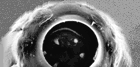
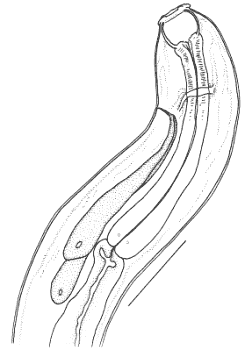
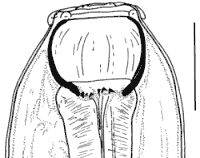
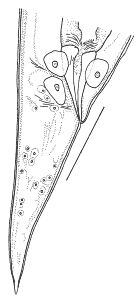
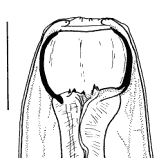
Entomelas entomelas, gravid (A, B, D)
and subgravid (C) individuals of hermaphroditic generation:
A - anterior end; B, C - head end; D - tail end.
Scale bars: A - 0.2 mm; B, C, D - 0.1 mm.
|
 |