|
 Entomelas
dujardini (Maupas, 1916) Travassos, 1930 Entomelas
dujardini (Maupas, 1916) Travassos, 1930
Synonyms: Angiostoma entomelas Dujardin, 1845 (part.), Rhabdias
dujardini Maupas in Seurat, 1916; Entomelas entomelas (Dujardin, 1845)
(sensu Baker, 1980, part.).
Host: Anguis fragilis (Reptilia: Sauria: Anguidae).
Site: lungs.
Distribution: Western Palaearctic (Europe, Caucasus).
Description
[All measurements are in micrometers unless otherwise indicated. The mean value
followed by limits in parentheses is given].
Adult hermaphrodites. Body length 5.06 (2.75 - 8.50) mm, maximum width 197
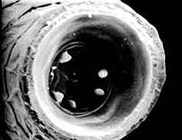
(107 - 332). Body cuticle swollen, especially in anterior part. Oral opening round.
Teeth small. Three of six teeth partially reduced and poorly visible in lateral view.
Buccal capsule 23 (18 - 28) deep and 28 (25 - 30) wide. Anterior end of oesophagus
approximately as wide as buccal capsule. Oesophagus club-shaped, 444 (274 - 664) long
(9.0 (5.5 - 14.8) % of body length). Width of posterior bulb 63 (48 - 86). Nerve ring
at 140 (130 - 160) from anterior end of oesophagus (32.1 (26.5 - 37.2) % of oesophagus
length). Excretory pore situated behind the level of nerve ring. Excretory glands
shorter than oesophagus. Intestine wide, thick-walled. Contents of intestine black
in posterior part. Distance from anterior end to vulva 2.51 (1.50 - 3.75) mm (49.8
(42.6 - 56.4) % of total length). Uteri wide, filled with numerous eggs. Eggs in uteri
of some species containing completely developed larvae. Tail with prominent thin cuticular
needle on the end. Tail length 192 (125 - 249) (3.9 (2.9 - 4.9) % of body length.
Subadult hermaphrodites differ from adults by thin, smooth body cuticle
and smaller body size. Body length 2.85 (2.58 - 3.32) mm, maximum width 98 (92 - 107).
Buccal capsule 21 (20 - 22) deep and 29 (27 - 30) wide. Oesophagus 412 (381 - 437)
long (14.5 (12.4 - 17.0) % of body length). Width of oesophageal bulb 53 (50 - 57).
Nerve ring at 135 (119 - 144) from anterior end of oesophagus (32.7 (29.7 - 35.9)
% of oesophagus length). Excretory glands prominent. Intestine comparatively narrow,
straight. Vulva at 154 (1.42 - 1.66) mm from anterior end 54.2 (48.4 - 56.4) % of
general length). Vulva lips distinct. Uteri narrow, empty. Tail conical, 140 (125
- 172) long (4.9 (4.4 - 5.4) % of body length). Tail end tapered, apical cuticular
needle sometimes less prominent than that in adult worms.
Biology
Life cycle rhabdiasoid. Free-living females with maximum 3 eggs in uteri. Usually
2 larvae develop in each female (matricidal hatching). Infective larvae were able
to infect terrestrial snails Deroceras sp. and Arion sp. (Kuzmin, Sharpilo, 2000).
Oral experimental injection of infective larvae resulted in successful development
of hermaphrodites in the host. Larvae migrated from digestive tube to body cavity
and thereafter penetrated lungs. Experimental hyperinfection resulted in arrested
development of hermaphrodites. Subadult individuals were found in body cavity of the
host.
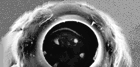
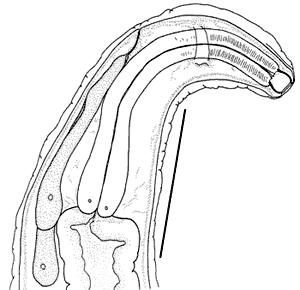
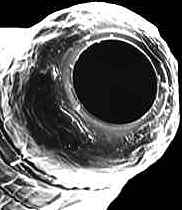
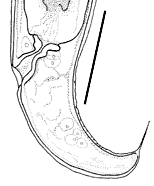
Entomelas dujardini, hermaphroditic generation adults:
A - anterior end; B - head end, subapical view; C - bottom of
bucal capsule; D - tail end.
Scale bars: A - 0.2 mm, D - 0.1 mm.
|
 |